
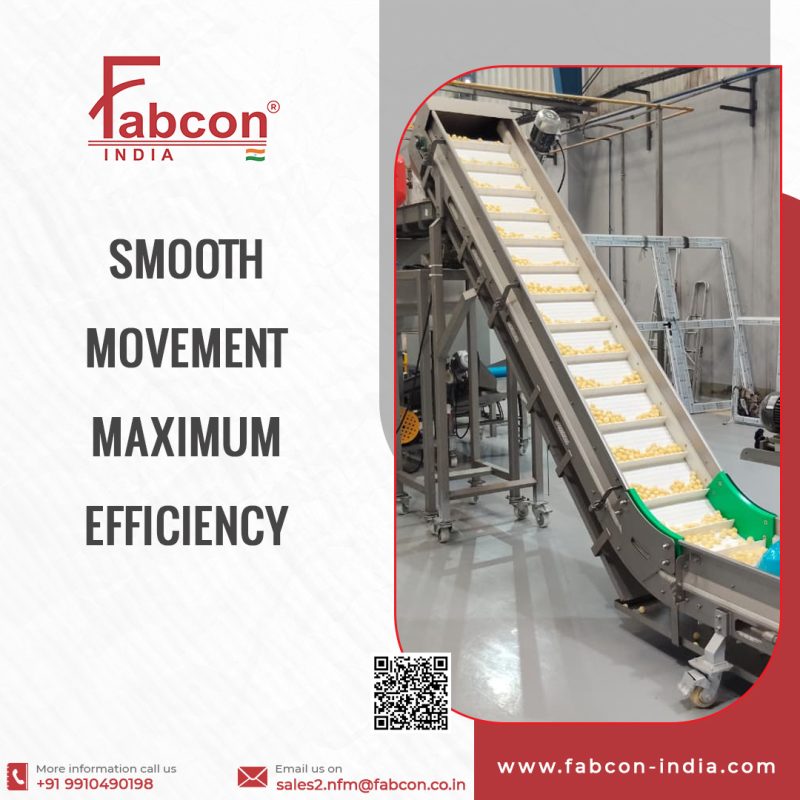
Belt Conveyor for Food Processing: Types, Benefits & Applications
In a modern food processing plant, efficient material handling is essential for maintaining continuous production. Products need to move smoothly from one processing stage to another without unnecessary manual handling, product damage or production delays.
A Belt Conveyor is one of the most widely used conveying solutions for transporting food products, ingredients and finished goods across processing and packaging lines.
Fabcon India offers customizable belt conveyor systems designed for food processing and packaging applications, including food-grade belt options and automated conveying solutions.
What Is a Belt Conveyor?
A belt conveyor is a continuous material-handling system in which a moving belt transports products from one location to another.
Depending on the product, layout and production requirements, belt conveyors can be designed for:
- Horizontal conveying
- Incline conveying
- Decline conveying
- Product transfer
- Cooling and inspection
- Feeding and collection
- Packaging line integration
For food processing applications, the conveyor can be configured with food-grade belts and hygienic construction.
Why Are Belt Conveyors Important in Food Processing?
1. Smooth Product Movement
A properly designed belt conveyor provides consistent product flow between different machines and processing stages.
This helps reduce manual handling and maintain a continuous production process.
2. Improved Production Efficiency
Automated conveying allows products to move continuously between equipment, helping manufacturers improve overall production efficiency.
3. Hygienic Food Handling
Food-grade belts and suitable stainless-steel construction help make conveyors appropriate for hygienic food processing environments.
4. Reduced Manual Handling
By automating product transportation, belt conveyors can reduce the need for manual movement of materials and improve workplace efficiency.
5. Flexible & Customizable Design
Every food processing plant has different requirements. Conveyor length, width, height, inclination, belt type and discharge arrangement can be customized according to the production layout.
Fabcon India specifically describes its belt conveyors as customizable and suitable for food and packaging industries.
Types of Belt Conveyors
Different products and production layouts require different conveyor designs.
Modular Belt Conveyor
Modular belt conveyors use interconnected belt modules that can be replaced or maintained section-by-section. They are particularly useful where flexibility and easy maintenance are important.
Incline Belt Conveyor
Incline conveyors are used to move products between different elevations.
They can be used for applications such as:
- Feeding packaging machines
- Moving snacks between processing stages
- Carrying bulk products
- Connecting different levels of a production line
PVC Belt Conveyor
PVC belt conveyors can be used for various food and industrial conveying applications where reliable and controlled product movement is required.
PU Belt Conveyor
PU belts are suitable for food-processing applications where hygienic product contact and easy cleaning are important.
Sidewall / Gooseneck Conveyor
Sidewall conveyors are useful when products need to be conveyed at an angle while minimizing product spillage and reducing the required floor space.
Applications of Belt Conveyors in Food Processing
Belt conveyors can be integrated into a wide range of production lines, including:
Snack Processing
Used for transporting extruded snacks, pellets, chips and other snack products.
Namkeen Processing
Used for transferring namkeen between frying, seasoning, cooling and packaging stages.
Bakery & Baked Snacks
Belt conveyors can transfer products between extrusion, baking, cooling and subsequent processing stages. Fabcon’s baked snack line, for example, uses belt conveyors for product transfer.
Packaging Lines
Conveyors can transfer finished products toward weighing, packaging, inspection and secondary packaging systems.
Food & Ingredient Handling
Suitable configurations can be used for transporting various food products and ingredients.
Fabcon’s food-grade conveyor systems are positioned for applications across food, grain, sugar, tea, pharmaceutical and other industries.
Key Benefits of Fabcon India Belt Conveyors
Fabcon India lists several key features for its belt conveyor systems:
✅ Fully customizable design
✅ Food-grade belt options
✅ Smooth product movement
✅ High conveying capacity
✅ Easy operation
✅ Easy maintenance
✅ Wear-resistant construction
✅ Belt alignment options
✅ Automation integration
✅ Low operating cost
How to Select the Right Belt Conveyor?
Before selecting a conveyor, manufacturers should consider:
1. Product Type
What product will be conveyed—snacks, pellets, chips, grains, bakery products or packaged goods?
2. Required Capacity
The conveyor should be sized according to the required production rate.
3. Belt Type
The belt material should be appropriate for the product and operating environment.
4. Conveyor Length & Width
Dimensions should match the available production space and product flow requirements.
5. Inclination
Incline or decline conveying may be required depending on the plant layout.
6. Hygiene Requirements
Food-contact applications require suitable food-grade and hygienic construction.
7. Automation
The conveyor should be capable of integrating with upstream and downstream machines when automation is required.
