
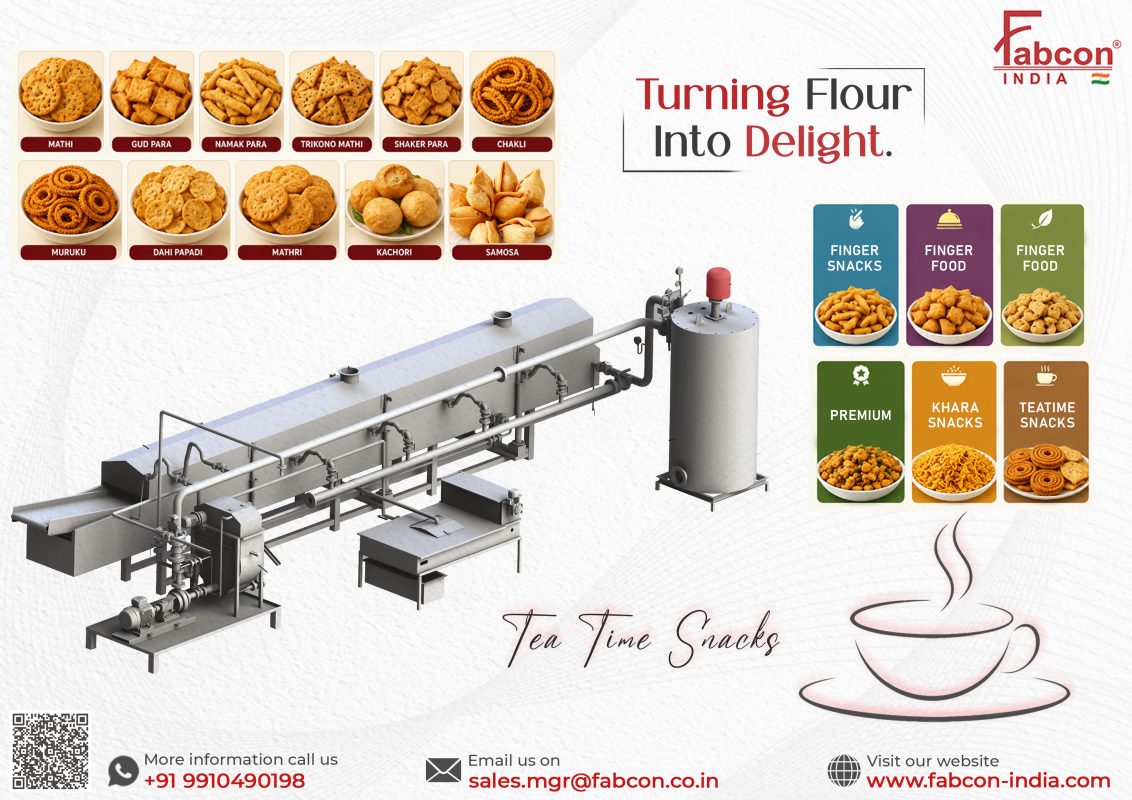
Kachori and samosa are among India’s most loved traditional snacks. From local sweet shops to large food brands, these products have a strong presence in the Indian snack market and international food industry.
With increasing consumer demand, manufacturers are moving from traditional manual production to automated food processing technology. Modern commercial food plants make it possible to produce kachori and samosa in larger quantities while maintaining consistent quality, shape, taste, and texture.
But how are these popular snacks manufactured on an industrial scale? Let’s explore the complete production process.
The first step in commercial kachori and samosa manufacturing is selecting and preparing the raw materials.
Common ingredients include:
- Wheat flour or refined flour (Maida)
- Edible oil or ghee
- Water and salt
- Potatoes, peas, lentils, or other filling ingredients
- Spices and seasoning
Accurate ingredient measurement helps maintain product consistency and ensures that every batch follows the desired recipe.
The selected flour, water, oil, and other ingredients are transferred to an industrial dough mixer.
The mixing process develops the required dough consistency, elasticity, and texture. Proper dough preparation is important because it directly affects the final product’s crispiness and structure.
Automated dough mixing systems help manufacturers achieve uniform dough quality while reducing manual labour and processing time.
The filling is prepared separately according to the product recipe.
For samosas, popular fillings include potato, peas, and spices. Kachori fillings may include moong dal, urad dal, onion, peas, or other regional ingredients.
The filling is mixed properly to achieve uniform ingredient distribution, taste, and texture.
After dough preparation, it is processed through a sheeting system to achieve the required thickness.
Samosa Forming Process:
The dough sheet is cut into suitable portions, shaped into cones, filled with the prepared mixture, and sealed to create the traditional triangular shape.
Kachori Forming Process:
Small dough portions are filled with stuffing and shaped into round products using suitable forming equipment.
Modern forming machines help maintain uniform product size, weight, shape, and filling distribution, improving overall production efficiency.
Frying is one of the most critical stages in commercial kachori and samosa production.
The formed products are transferred to an industrial continuous fryer, where controlled oil temperature and conveyor movement help achieve uniform frying.
Modern industrial frying systems offer:
- Controlled frying temperature
- Uniform golden-brown colour
- Consistent frying time
- Improved product quality
- Reduced manual handling
- Higher production efficiency
The required frying temperature and time depend on the recipe, product size, filling, and desired final texture.
After frying, the products move onto a de-oiling conveyor to remove excess surface oil.
They are then transferred to a cooling conveyor, where they gradually reach the required temperature before further handling and packaging.
Proper cooling helps maintain product quality and reduces the risk of moisture condensation inside the packaging.
Quality control is essential in commercial snack manufacturing.
Finished kachori and samosa are checked for:
- Uniform shape and size
- Consistent golden-brown colour
- Proper frying and texture
- Product weight
- Filling distribution
- Overall appearance
Manufacturers can also integrate automated inspection systems to improve quality control and reduce product rejection.
Once the products pass quality inspection, they are transferred to the packaging section.
Depending on the product type and market requirements, manufacturers can use:
- Automatic weighing systems
- Pouch packaging machines
- Vacuum packaging systems
- Modified Atmosphere Packaging (MAP)
- Frozen food packaging solutions
